Showing posts with label Kingdom plantae. Show all posts

Thursday, 7 June 2012

Journal entry

For my journal entry I chose to sit outside at on a bench in a park in an area near my house. 

As I observed the ecosystem around me I snapped photos, and here they are!
These trees are angiosperms, they are producers.

This tree is a gymnosperm, it is a producer

These trees are also gymnosperms and producers.

This is a tree stump, and grass. 
This is a patch of moss on the ground.


This is a pine cone beside the bench. Pine cones come form gymnosperms.

If you look far in the background you can see a patch of ferns. Ferns are producers.

This is a robin, robins are part of the animal kingdom and are consumers

This is another pine cone on the ground beside my foot
The little circle in the grass is a Fungi fruiting body called a mushroom.  Mushrooms are decomposers.

This is a close up version of the mushroom. 
This is a picture of a spider. Spiders are part of the animal kingdom, and are arthropods.  They are consumers.

Newspaper article


http://www.vancouversun.com/news/Want+safer+city+green+researchers/6709876/story.html

The article that I have chosen is from the Vancouver sun. This article involves plants because it is about how planting trees would lower crime in cities. "Researchers with the University of Vermont and the U.S. Forest Service found that a 10 per cent increase in tree cover was associated with a 12 per cent decrease in crime." Contrary to the belief that tree cover can be used by criminals to hide, trees can have a positive effect on our society. Studies have found that with more members of the kingdom plantae planted around urban cities, the areas look more well kept and criminals think that law enforcment is high.  "One theory, cited in the study, suggests that trees have a deterrent effect on criminals because they encourage residents to spend more time outdoors, which means more "eyes on the street." " But still, a lot more research needs to be done to prove that trees actually have a deterrent effect on criminal behaviour.

Tuesday, 5 June 2012

Gymnosperms


What are characteristics that unify gymnosperms? 
Gymnosperms literally means "naked seed". In gymnosperms a number of their leaves have evolved into scales. These scales are used in reproduction. Scales are grouped into larger structures called male and female cones. Fertilization is by pollen, not from mobile sperm.The female cones produce the eggs, while the male cones produce the pollen. Gymnosperms are the most ancient surviving seed plants.


This is a photo of the female and male cones. 
Below is a diagram showing the alternation of generations in gymnosperms. 
Gymnosperms have developed seeds that encase and protect their embryos. The dominant phase in the gymnosperm life cycle is the diploid (sporophyte) stage.


How do gymnosperm features aid in survival in a land environment? 


  • Gymnosperm's roots extend over a wide surface area rather than penetrating deep into the soil. This feature lets them grow tall and holds the tree firm and provides a source of water and nutrients from the soil.
  • Gymnosperm stems are used in the transport of nutrients throughout the plant.  
  • Gymnosperms leaves are usually in the form of needles that stay green throughout the year.  Thin needle like leaves are an adaptation  to the harshness of hot, dry summer, cold winter and moderate rainfall.
  • Gymnosperm seeds have protection and nourishment for developing embryo and can wait a long time to germinate when conditions are good.The seeds of gymnosperms are not enclosed within fruits. 
  • In gymnosperms, the movement of pollen (male gamete) to ovule (female gamete) relies on airborne transport; No need for water to ensure fertilization. Most gymnosperms produce huge amounts of pollen. 
  • Gymnosperm's vascular tissue, is extensive and makes up the bulk of the stem. This is what conducts water and nutrients up the body of the tree.

Monday, 4 June 2012

Ferns


What characteristics unify ferns?

Ferns thrive in wet and seasonally wet environments like tropical rainforests. Ferns have specialized tissues called vascular tissues. These tissues transport water and products of photosynthesis throughout the plant. Ferns have true roots, stems called rhizomes, and large leaves called fronds.
Spores are produced in the Sporangia. When the spores are ripe, they are released. 

The diploid Sporophyte is the dominant obvious stage. The haploid Gametophyte is tiny and only lives for a short time.


What features do ferns have that have enabled adaptation to a land environment? 

Ferns have true roots and vascular tissue that allows water to move farther through the plant. They don't depend on absorption of water held in the plant.  In ferns the vascular system is well developed, enabling it to live in drier conditions. Fern fronds leaves are a modification for more efficient photosynthesis


Saturday, 2 June 2012

Mosses


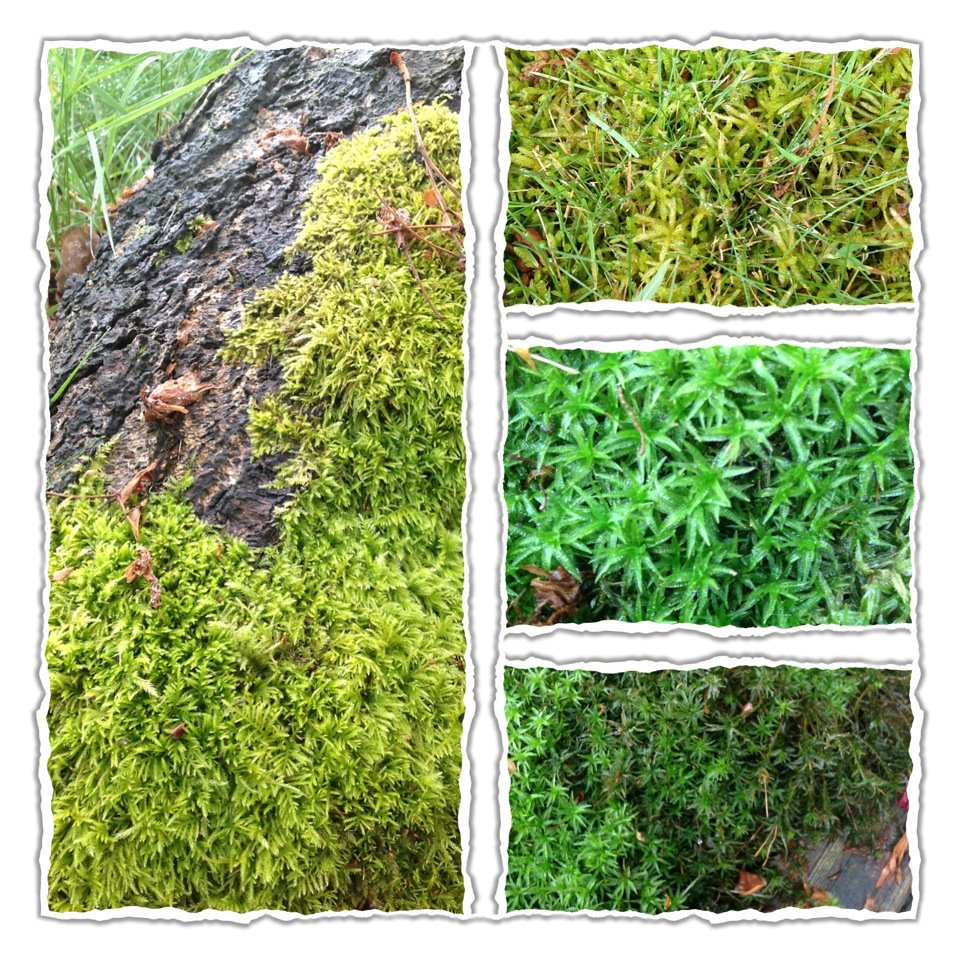
Mosses growing on a tree and on my lawn
What characteristics unify mosses? 

Mosses are part of the phylum Bryophyta. Mosses need to live in a wet environment to survive. They thrive and grow most abundantly in  bogs, swamps, moist woods, and near streams. Mosses vary in appearance, but most are less than a few centimetres tall. They lack the water conducting tubes that are found in more complex plants, true roots, stems or leaves. 

This is an illustration of the typical moss plant
This diagram explains how mosses reproduce via alteration of generations. Alternation of spore producing generation (sporophyte 2n) with gamete producing generation (gametophyte n). 


What features do mosses have that have enabled adaptation to a land environment?

Mosses have several features that have enabled them to adapt to land environments. They have developed a multicellular plant body. Special structures like rhizoids developed which absorb water and are used for anchorage. They also have photosynthetic tissue that help in the absorption of carbon dioxide without losing much water from exposure to light.


Multicellular green algae

Green algae is part of the phylum Chlorophyta. One important characteristic is that all algae must live in or near a source of water. Green algae contain chlorophyll, and  they have photosynthetic pigments. Green algae always store their food in the form of starch. Green algae have chloroplasts that are enclosed in a double membrane. Most multicellular green algae develop specialized tissues, but they lack leaves, and roots like the more complex plants of this kingdom. Green algae are isogamus, which means that rather than having separate male and female gametes, they have only one type of gamete. Below is a diagram of the life cycle of green algae. 


Haploid spores turn into a haploid leaf-like structure called a thallus. The thallus then produces gametes. When these gametes are fertilized, they change into Diploid zygotes. which under go meiosis and produce spores.

Below is a picture of Oedogonium algae

Green algae can corm long threadlike colonies like the ones depicted above. These colonies are called filaments. Oedogonium  algae often grow in ponds. 
Where do algae fit into the world? Algae provides homes for many animals; Is an important source of food. Humans use algae in many of the foods eaten today! Without algae, life as we know it would never have evolved, because algae produces much of the Earth's free oxygen through photosynthesis. The chemicals in algae are used for many different things such as medicines, processed products, and cosmetics. Algae is a very important part of our lives. 

Friday, 1 June 2012

Kingdom Plantae


What is a plant?

A plant is a photosynthetic, eukaryotic, multicellular organism part of the kingdom Plantae. Plants typically have walls containing cellulose, lack of mobility and have  alternation of generations in their life cycles. The kingdom Plante is made up of many magnificent living organisms. Fungi, bacteria, and blue-green algae are often thought to be part of this kingdom but are actually parts of the other five kingdoms.

Phylum Magnoliophyta (Flowering plants),   Phylum Filicinophyta  (Ferns), Phylum Bryophyta (Mosses)